


About Traffic Engineering
The Traffic Engineering Division of the Public Works Department facilitates the safe and efficient movement of traffic including pedestrians and bicyclists within the city by applying state-of-the-art traffic and transportation engineering technology and methods.
We strive to optimize the traffic flow on arterial streets; enhance roadway, neighborhood and school zone safety; and improve traffic management citywide.
Through the implementation and maintenance of traffic tools and measures, we are able to improve roadway conditions, maximize intersection operation, heighten driver awareness, and increase public safety.
Report an Issue with SeeClickFix
Submit each issue separately with the correct address. Include pictures, videos, and detailed descriptions.
SeeClickFix is not monitored 24/7. Urgent infrastructure issues should be reported to the City’s 24-hour Hotline at (916) 687-3005. Examples of urgent issues include flooding, fallen tree/branches in the roadway, dark traffic signal, or Stop sign down/missing. Issues related to public safety should be reported directly to the Elk Grove Police Non-Emergency Line at (916) 714-5115 or if an emergency call 911.


Traffic Congestion
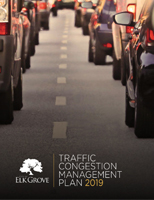
Addressing traffic congestion on city streets is a priority for Elk Grove. The City has developed the TCMP Traffic Congestion Management Plan to summarize completed actions, ongoing activities, as well as proposed future solutions that City staff is actively working on to help alleviate traffic. If you have questions regarding traffic congestion, please contact our Public Works Department at (916) 687-3005.
Speed Limits
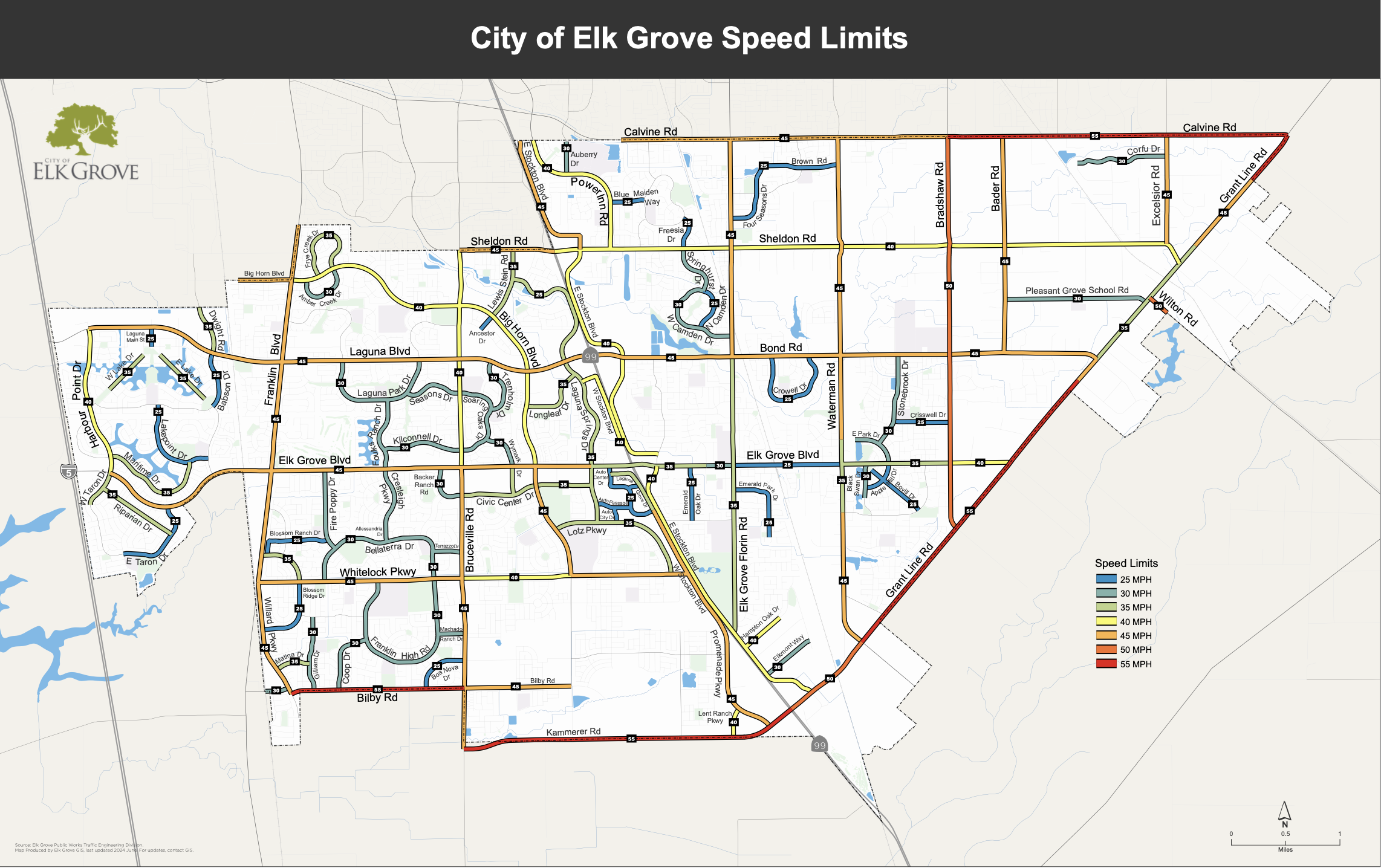
Cities and Counties in California are required to follow the California Vehicle Code (CVC), primarily Sections 22357 and 22358, to establish speed limits within their jurisdictions. The law requires speed limits to be set by ordinance on the basis of an engineering and traffic survey. Following the CVC requirements allows local law enforcement to use radar equipment to enforce the speed limit.
Below is a Speed Zone Map showing the established speed limits throughout the city. Residential speed limits are not shown.
Traffic Volumes
Traffic volumes play a pivotal role in traffic engineering, serving as a fundamental metric that guides various aspects of transportation planning and management. Understanding traffic volumes is crucial for assessing the safety of road networks enabling engineers to identify high-risk areas and implement safety measures effectively. Moreover, traffic volumes help in optimizing traffic signal timing at intersections, ensuring smoother traffic flow and reduced congestion. This data is also vital for forecasting future developments and planning improvements to accommodate growing populations and changing transportation patterns. In this context, the concept of "peak volume" emerges as a key term, denoting the maximum traffic flow experienced on a road or intersection during a specific time period, typically during rush hours. Accurate knowledge of peak volumes aids engineers in designing infrastructure that can handle the heaviest traffic loads, thereby enhancing overall road network efficiency and safety.
Traffic volume data is reported for streets maintained by the City of Elk Grove. Traffic volume data for State Highways and Interchanges is available to view from Caltrans.
Please note: This program started in 2019 and there are several locations that have been identified that have not been counted yet. As this data is collected the website and map will be updated to include this data.
Traffic Management Center
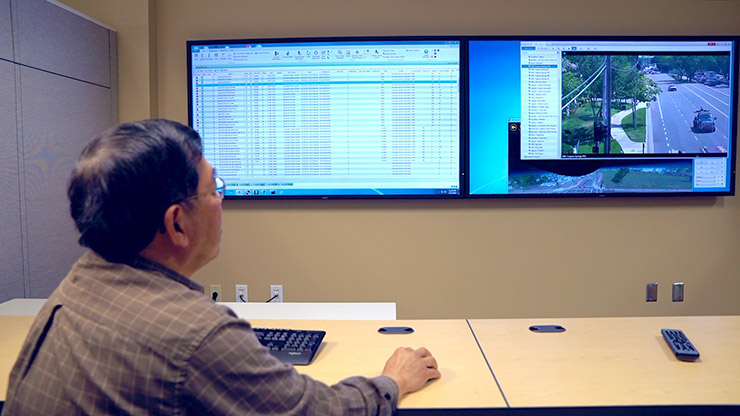
Staff at the Traffic Management Center monitors live video of major intersections and roadways.
Information gained from monitoring traffic is used to optimize traffic flow by adjusting signal timing. Traffic tools allow us to improve roadway conditions and maximize intersection operations.
Monitoring traffic also allows us to rapidly respond to incidents as they occur.
Roundabouts and Traffic Circles
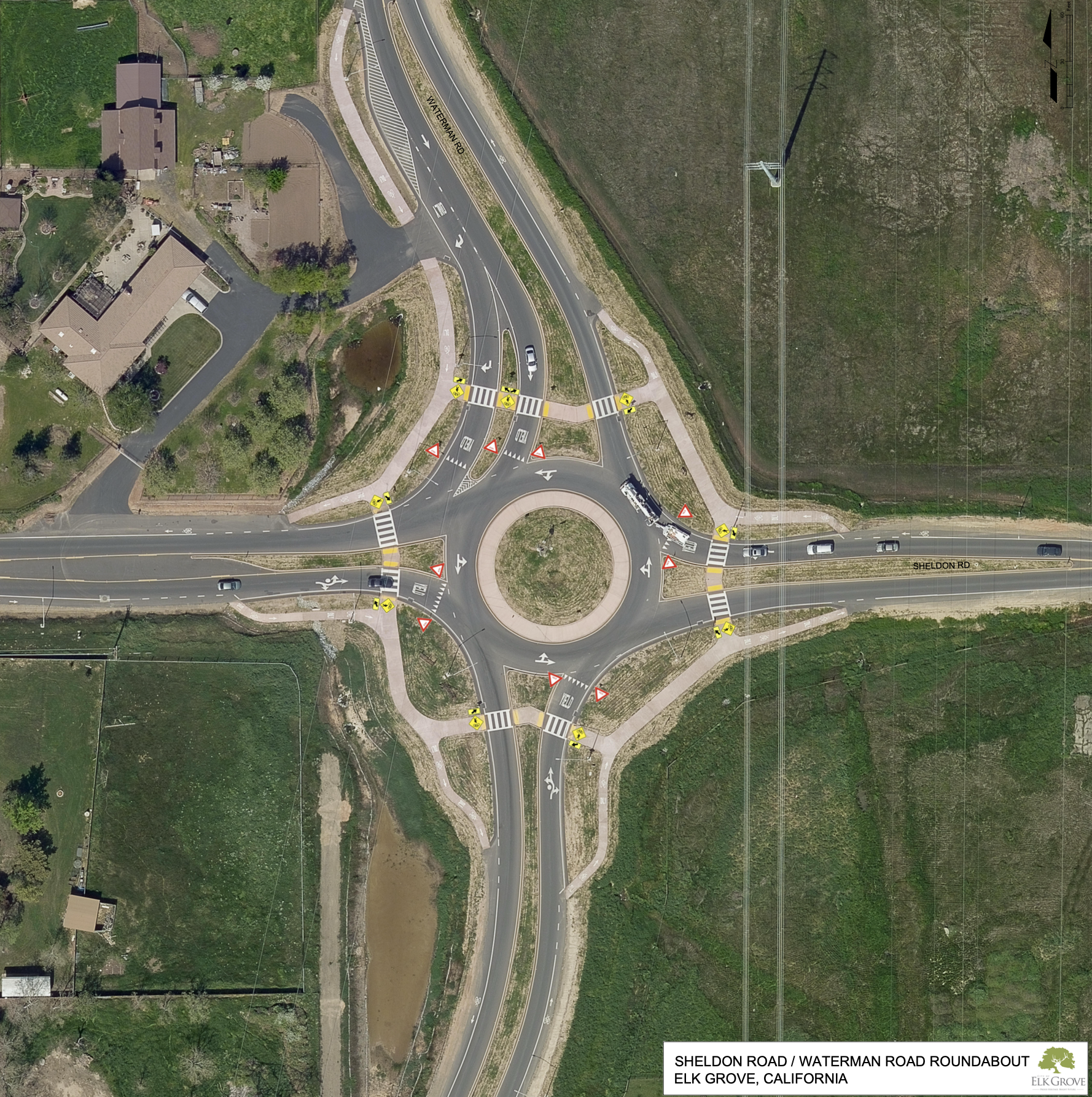
A roundabout or traffic circle is a type of circular intersection in which road traffic is permitted to flow in one direction around a central island, and priority is typically given to traffic already in the intersection. Compared to traffic signals, roundabouts reduce the likelihood and severity of collisions greatly by reducing traffic speeds and minimizing conflict areas. For pedestrians, traffic exiting the roundabout comes from one direction, instead of three at a signal, simplifying the pedestrian's visual environment. Traffic moves slowly enough to allow visual engagement with pedestrians, encouraging deference towards them. Other benefits include reduced driver confusion associated with perpendicular junctions and reduced queuing associated with traffic lights. They allow U-turns within the normal flow of traffic, which often are not possible at other forms of junction. Moreover, since vehicles that run on gasoline typically spend less time idling at roundabouts than at signals, using a roundabout potentially leads to less pollution.
Should you have any questions, please contact Public Works at (916) 687-3005.
Neighborhood Traffic Management
The City of Elk Grove wants to ensure our streets and neighborhoods are safe and has adopted a speed control program to allow residents to work with city staff to address traffic concerns in your neighborhood. There are many traffic calming tools to select from that help reduce speeds on neighborhood streets, such as speed humps, signage and striping. City staff reviews those tools and helps neighbors select the appropriate calming technique.
Speed control concerns may be reports to the City Traffic Engineer by submitting a request through the SeeClickFix app or by calling (916) 478-2256.
Preferential Parking Zone Program
The City of Elk Grove's Preferential Parking Zone Program helps address parking issues in residential neighborhoods by making on street parking by permit only. To start the process to establish a zone, a petition must be provided to Public Works that shows at least 75% of the residences are in support of creating such a zone. This petition is available for your use. Please note that only one vote is allowed per residence. Once the petition is received, Public Works staff will review the request and, if it qualifies, will forward to the City Council for consideration. If approved, the permits would be issued by the Public Works Department. Permits would be issued for each vehicle owned by a resident along with one guest permit per residence. Verification of residential status would require the current vehicle registration and a driver's license or utility bill showing the street address. There is no cost for the permits and they do not have an expiration date. Vehicles parked off the street, such as in driveways, would not need a permit.
If you have any questions please email us or call (916) 478-2256.
Autonomous and Connected Vehicles
The CAV Plan will help Elk Grove prepare for the future arrival of automated and connected vehicles operating on city streets. This plan provides an overview of CAV technologies, including estimates of when CAVs may become commercially available; identifies the potential effects (both positive and negative) of CAVs on the City and it's infrastructure; and proposes strategies the City may consider using to leverage the opportunities and/or face the challenges that come with CAV implementation.
State Route 99 North Bound Auxiliary Lanes
The City of Elk Grove partnered with the California Department of Transportation (Caltrans) on the recently completed State Route 99 Northbound Auxiliary Lanes from Elk Grove Blvd to Calvine Rd Project. The goals of the project are to reduce traffic congestion and enhance traffic flow by adding auxiliary lanes on northbound State Route 99 between:
- Elk Grove Blvd and Laguna Blvd/Bond Rd
- Laguna Blvd/Bond Rd and Sheldon Road
- Sheldon Rd and Calvine Rd
An auxiliary lane connects a freeway on-ramp to the subsequent freeway off-ramp; this becomes an “exit only” lane at the downstream off-ramp. Auxiliary lanes allow traffic to adjust to the proper speed in a designated area before merging into or out of the main traffic lanes and provides for easy access between adjacent interchanges without the need to enter mainline traffic.
The proper use of auxiliary lanes reduces traffic congestion and increases safety by reducing weaving of traffic and the number of conflicts between slow and higher speed vehicles. When entering a freeway, drivers use the on-ramp and auxiliary lane to accelerate to the proper speed, matching the flow of traffic, before merging with mainline traffic. Similarly, when exiting the freeway, drivers merge into the auxiliary lane and then reduce their speed to safely exit the freeway.
Contact
Traffic Engineering
(916) 478-2256
Kristin Parsons
Interim Traffic Engineering Manager
(916) 478-2236
Email


