Purpose
Policy and Procedure No.: B-26-40
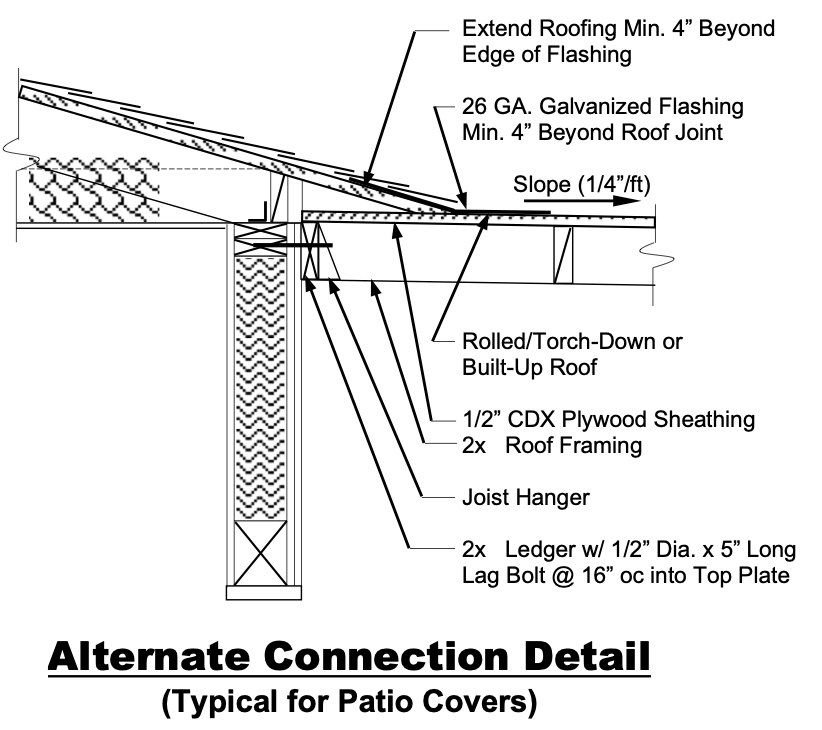
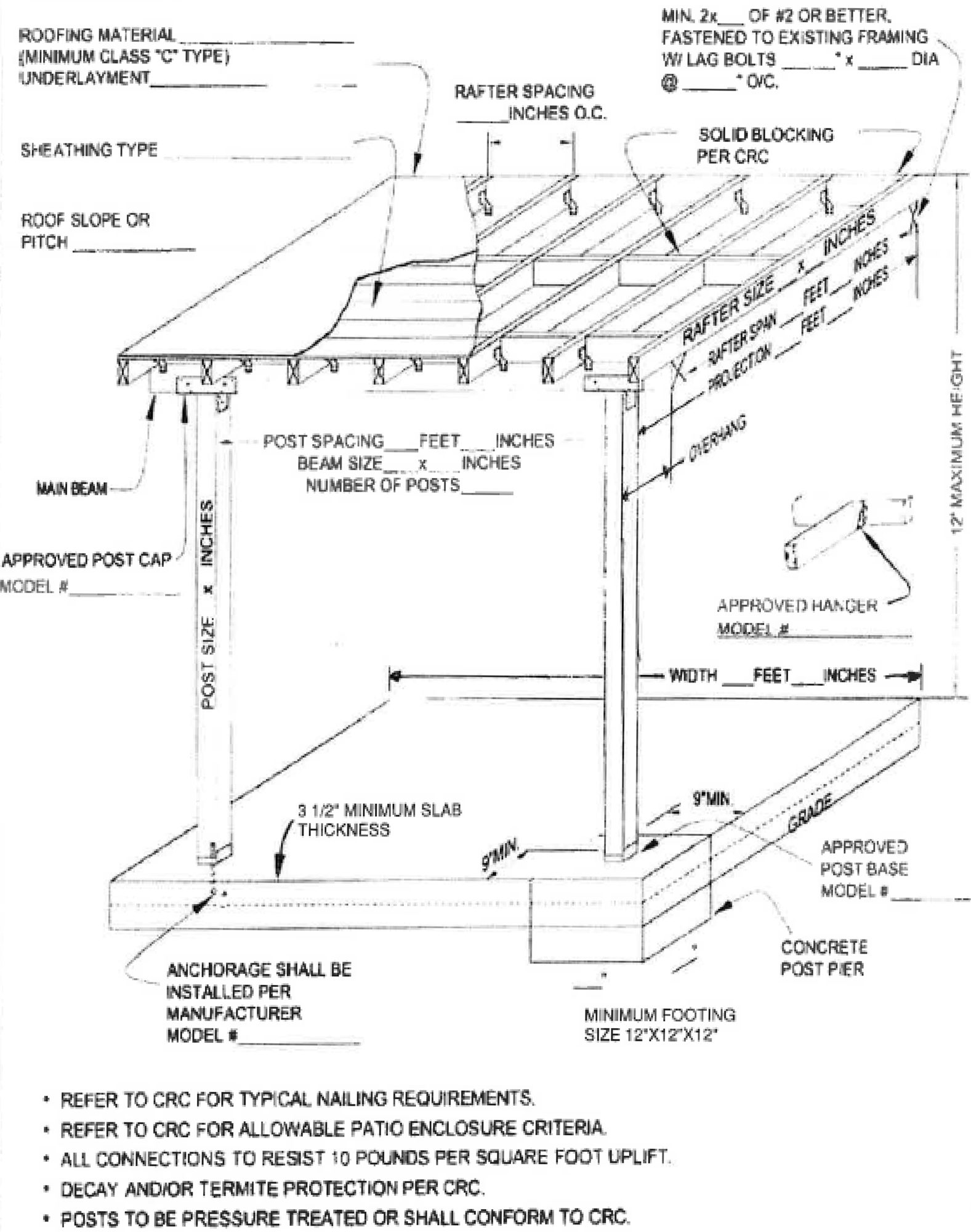
The sample illustrations show how an attached unenclosed patio structure may be built utilizing the California Residential Code (CRC) and California Building Code (CBC) “Conventional Light Wood- Frame Construction Guidelines”. The conventional method allows “repetitive” members in the designs of walls, floors and ceiling, are prescriptive, and ordinarily do not require a structural design to comply with the code. For information regarding plan submittals and specific design limitations for residential patio covers refer to Policy and Procedure No. B-04-04 “Residential Patio Covers and Accessory Buildings” (Sheds, Arbors, Trellises).
Exemption: (CBC, Section [A] 105.2)
One story Detached Accessory Structures used as tool and storage sheds, playhouses, etc. 120 sq. ft. in floor area or smaller, with not more than 12- inches of overhang extending beyond the exterior wall of the structure do not require a building permit.
Allowed Locations
Submitted design plans shall require review and approval by the City of Elk Grove Planning Division staff to review the Zoning Code restrictions for maximum building coverage allowed, height limitations, property line setbacks and maintenance/public utility easement setback distances. This review will be internally routed by the Building Division during the plan review process.
It is recommended that you contact the Planning Division prior to submittal to confirm that the proposed patio cover meets zoning code requirements.
The Planning Division can be contacted by phone at (916) 478-2265 or by email.
Design Provisions
Patio Cover Limitations
The following patio cover illustrations are only applicable in residential dwellings classified as R-3 Occupancies. Patio covers are not designed or intended to be used as room additions which require compliance with code provisions such as heating, waterproofing, and normal live and wind loads. Furthermore, patio covers cannot always be converted to complying room additions.
Plan Submittal and Permit Processing
For plan submittal and permit processing information, please visit our Minor Residential Building Permits webpage.
What information is needed to obtain a building permit?
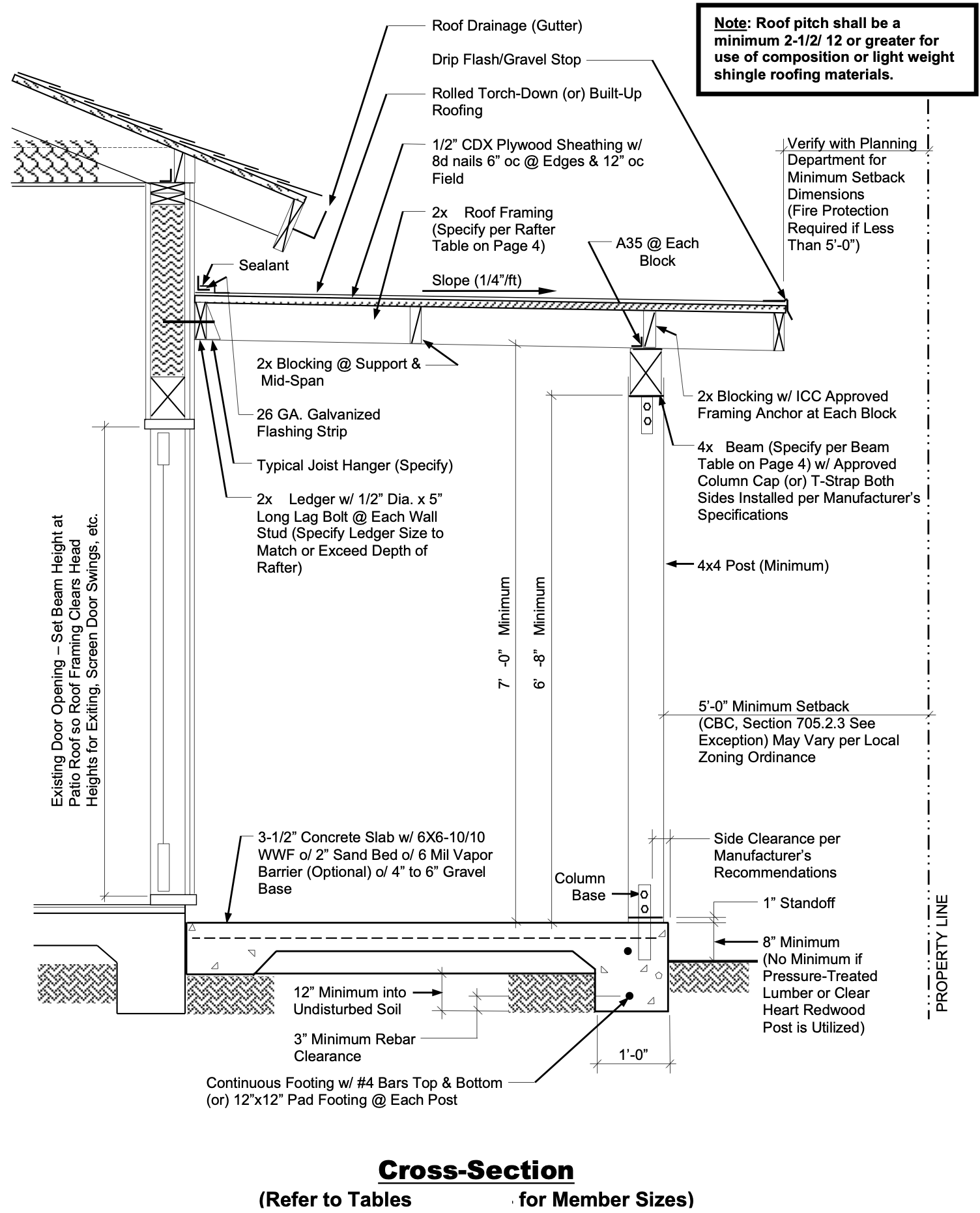
Included in the plan submittal should be the following information which clearly depicts the proposed patio cover construction and its relationship to the entire lot. Information such as the size and spacing of all framing members; attachment detail to the exterior wall; roof covering material, connection specifications for beam to post, and for post to footing, etc.
Plan Submittal Requirements:
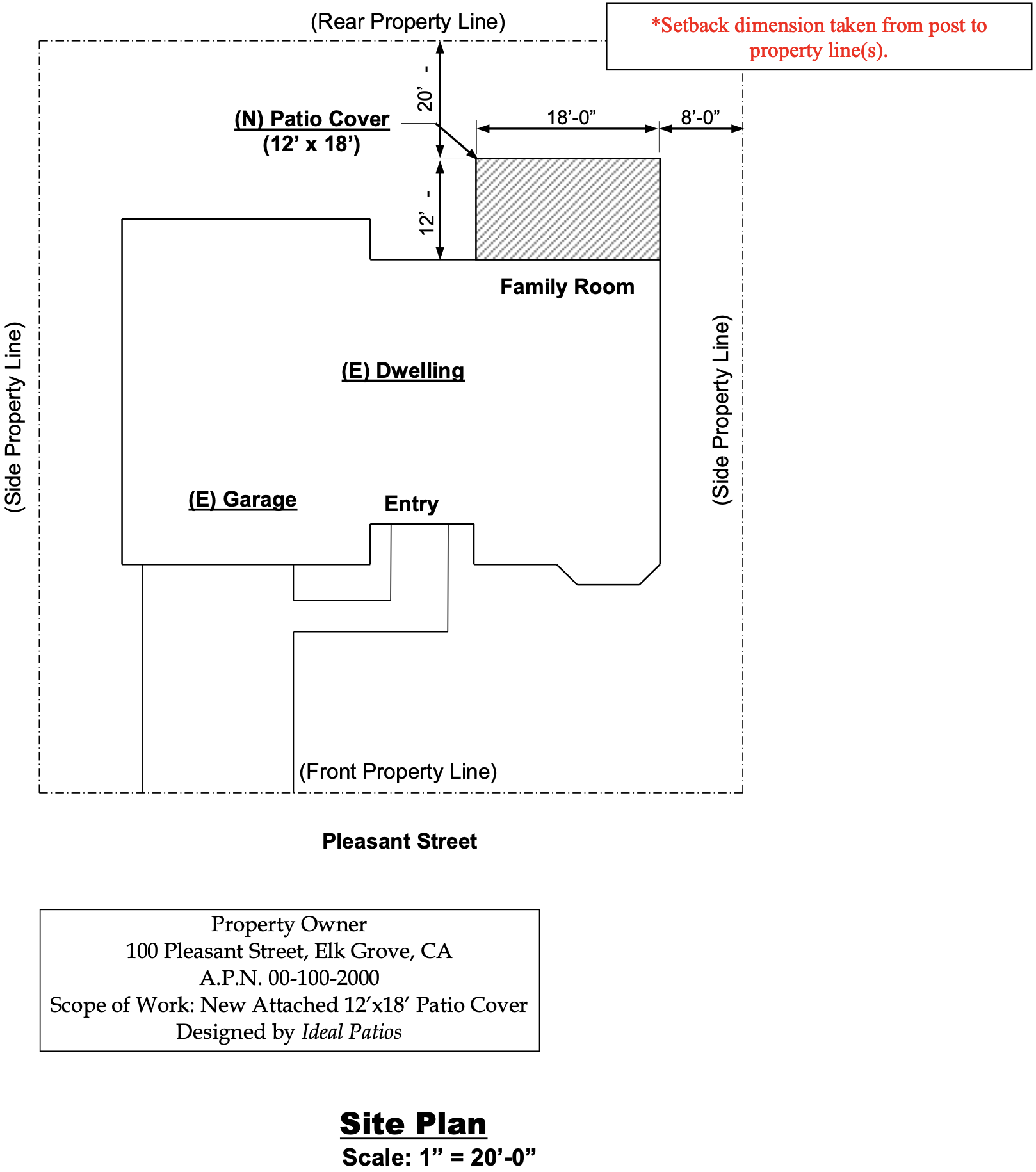
- Site Plan. Please refer to the sample site plan below
- Elevation(s)
- Roof Framing
- Cross-Section
- Framing Details
You may refer to the tables below and highlight proposed structural members for allowable size and spacing. Otherwise, a structural analysis/evaluation may be required by a professional engineer licensed in the State of California for the design of structures of unusual shape and/or structures supporting tile roofing materials (i.e., cellulose, cement).
Allowable Spans For Douglas Fir #2 Roof Rafters
Dead Load = 10 psf and Includes Maximum Roofing Material Live Load = 20 psf, L / = 180
|
Rafter Size |
Spacing |
Allowable Span |
|---|---|---|
|
2x6 |
24” 16” 12” |
11’-11”14’-7” 16’-10” |
|
2x8 |
24” 16” 12” |
15’-1” 18’-5” 21’-4” |
|
2x10 |
24” 16” 12” |
18’-5” 22’-6” 26’-0” |
|
2x12 |
24” 16” 12” |
21’-4” 26’-0” Spans 26’ or greater require engineering. |
Type V construction is a classification of buildings by construction materials and methods. It is the least restrictive permitted by the California Residential Code (CRC) and includes light wood-frame construction. This sheet is for information and reference only and is not a substitute for accurate drawings prepared for each proposed construction project.
Allowable Spans For Douglas Fir #2 Ceiling Joists (Table R802.5.1(2)
Dead Load = 5 psf
Live Load = 10 psf, L / = 240
|
JOIST SIZE |
SPACING |
ALLOWABLE SPAN |
|---|---|---|
|
2x4 |
24” 16” 12” |
9’-10” 11’-3” 12’-5” |
|
2x6 |
24” 16” 12” |
15’-0” 17’-8” 19’-6” |
|
2x8 |
24” 16” 12” |
19’-1” 23’-4” 25’-8” |
|
2x10 |
24” 16” 12” |
23’-3” Spans 26’ or greater require engineering. |
Allowable Spans For Beams without Ceiling
Based on Maximum Tributary = 10’-0” (Span = 20’-0”)
|
Span |
Beam Size |
|---|---|
|
Up to 5’-4” |
4x4 |
|
5’-5” to 7’-9” |
4x6 |
|
7’-10” to 10’-6” |
4x 8 |
|
10’-7” to 12’-9” |
4x10 |
|
11’-10” to 15’-0” |
4x12* |
|
*4x12 DF #1 may be used over a 16’-0” garage door in one story open patio or carport structures. |
|
Allowable Spans For Beams with Ceiling
Based on Maximum Tributary = 10’-0” (Span = 20’-0”)
|
Span |
Beam Size |
|---|---|
|
Up to 4’-8” |
4x4 |
|
4’-9” to 6’-10” |
4x6 |
|
6’-11” to 9’-0” |
4x 8 |
|
9’-1” to 11’-0” |
4x10 |
|
11’-1” to 13’-0” |
4x12* |
|
*For spans greater than the table values, engineered calculations are required. |
|