
Climate Compass
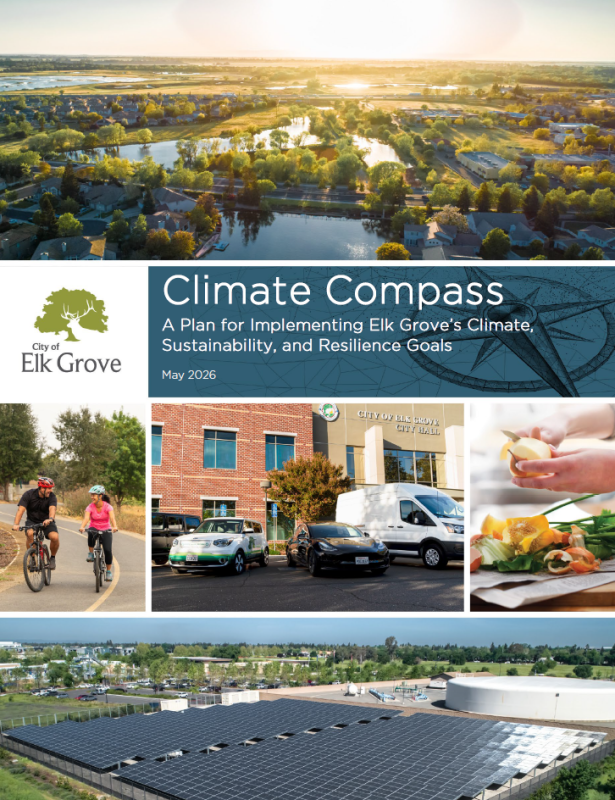
The Climate Compass: A Plan for Implementing Elk Grove's Climate, Sustainability, and Resilience Goals is the latest update to the City's climate commitment. This document provides a roadmap for the City to achieve state-recommended targets for greenhouse gas emission reductions and it addresses climate adaptation – identifying actions to address the climate change we are already seeing and expect in the future – and supports the City’s broader sustainability and resilience goals.
Check out our Climate Compass Dashboard(external link) to follow our progress as we implement the Climate Compass.
Sign Up For Updates
Environmental Documents
- Notice of Preparation (NOP) - Public Review Ended January 15, 2025
- Scoping Meeting Slide Deck - Meeting held on January 9, 2025
- Draft Supplemental Environmental Impact Report - Released on June 27, 2025
- Draft SEIR Appendix A - Released on June 27, 2025
- Final Supplemental Environmental Impact Report
- Findings of Fact
Climate Compass
The development of the Climate Compass, the update to the 2019 Climate Action Plan, started in spring 2023 and continued through summer 2026. There were many opportunities for public engagement.

The goal of the Climate Ambassador Program is to improve resident knowledge of and engagement around climate efforts. Climate Ambassadors are encouraged to have conversations with members of their community and share input on how Elk Grove can be healthier, more sustainable and resilient. Climate Ambassadors use their existing knowledge and gain additional understanding of topics around climate change, environmental justice, equity, renewable energy, clean transportation, water conservation, and recycling and waste. These efforts will help to develop a more community and equity focused Climate Compass and support greater community participation in reaching the climate goals.
If you are interested in hearing more about the Climate Ambassador Program, please reach out to Grace Kaufman ([email protected]).
Frequently Asked Questions
What is the Climate Compass?
The Climate Compass is the name for the City of Elk Grove’s climate action plan (CAP). It is a comprehensive and transformative roadmap for addressing climate change while supporting the City’s broader sustainability and resilience goals.
Why did the City of Elk Grove update its Climate Action Plan?
The purpose of the Climate Compass is to identify measures and approaches that reduce greenhouse gas (GHG) emissions and help the City adapt to the current impacts of climate change. It serves to guide City staff in implementing climate, sustainability, and resilience goals that meet present needs without compromising the ability of future generations to meet their own needs. The Climate Compass ensured Elk Grove is consistent with State GHG reduction targets such as the statewide carbon neutrality target and as a California Environmental Quality Act (CEQA)-qualified CAP.
What is mitigating and adapting to climate change?
Mitigation is the process of lessening heat trapping GHG emissions that contribute to climate change. Using baselines GHG emission calculations, the City can project future GHG emissions to help develop targets and strategies intended to reduce future emissions. Strategies can include decreasing where these GHG gases come from, like reducing the burning fossil fuels for energy, or enhancing the places that store these gases, like better managing urban forests and soil.
GHG Mitigation Planning Process
- Establish a baseline GHG emissions inventory
- Project future GHG emissions
- Set GHG emissions reduction targets
- Identify strategies to meet GHG reduction target
Adaptation refers to the process of assessing and responding to climate change's current and future impacts. The City can measure its adaptive capacity to respond to these impacts by assessing climate-related hazards and pinpointing vulnerabilities to develop effective strategies. Adaptation strategies will include efforts to improve community resilience and help prepare for climate hazards like extreme weather events, wildfires, increased temperatures, flooding, and drought.
Adaptation Planning Process
- Evaluate exposure to climate change-related hazards
- Analyze sensitivity to these hazards and identify vulnerabilities and potential impacts
- Determine adaptive capacity to prepare for an adapt to these impacts
- Develop adaptation strategies to improve community resilience
What is a CEQA-qualified CAP and why has the City developing one?
A CEQA-qualified CAP is one that meets State requirements so that future development projects requiring CEQA can streamline GHG impact analyses by demonstrating consistency with the CAP. It will allow for consistency in the GHG reducing and climate adaptation features that are included as part of the design of new development projects.
Demonstrating compliance with a CEQA-qualified CAP provides a simple, clear, and defensible option for project-level analyses to determine that its incremental contribution is not cumulatively considerable. This approach is supported and recommended by the California Air Resources Board, Governor’s Office of Planning and Research, multiple local air districts, and has been reinforced through CEQA case law.
What benefits are there for Elk Grove residents?
The Climate Compass strategies and actions supporting reduced energy consumption in buildings, which can lead to substantial cost savings for residents that participate. It provides alternative transportation options through non-motorized travel modes, reduces the number of vehicles on the roads, and supports the electrification of vehicles so that less emissions occur. The plan also identifies strategies to address climate vulnerabilities to reduce climate impacts from extreme weather events, temperature increases, wildfires, flooding, and drought. The result should be improved air quality, better livability, and more affordability.
Why should I get involved?
A successful CAP will rely on collaboration with residents, business owners, community leaders, and advocates in underserved communities. The Climate Compass reflects the Elk Grove community’s priorities and vision, so it is important that we hear from as much of our community as possible to ensure climate risks or potential recommendations are not overlooked, as well as reducing the potential for unintended consequences of proposed measures.
How can I stay involved in the process?
Sign up for periodic updates at the top of this page. The City will continue to update the website with pertinent information and opportunities to be involved. Thank you for taking the time to be part of the Climate Compass process and making Elk Grove a better place to live and work!
Is it Climate Compass or CAP?
Both! The City has branded the latest CAP as Climate Compass: A Plan for Implementing Elk Grove’s Climate, Sustainability, and Resilience Goals.
Can you define greenhouse gases and climate change?
GHGs are gases that trap heat in the atmosphere, and consist mainly of water vapor, carbon dioxide, methane, nitrous oxide, ozone, and chlorofluorocarbons. GHGs provide an insulating effect to Earth, which is necessary to support life. However, the combustion of fossil fuels and other human-caused activities since the Industrial Revolution in the 19th century have introduced GHGs into the atmosphere at an increasingly accelerated rate. These significantly elevated levels of GHGs above natural ambient concentrations have caused a trend of unnatural warming of the Earth’s climate. This effect, known as global climate change, is the driver behind changes in extreme weather patterns, rapid melting of the polar ice caps, an increase in sea level, and other impacts to biological resources and humans.
Three primary GHGs are quantified in the City’s inventory: carbon dioxide (CO2), methane (CH4), and nitrous oxide (N2O).
How are GHG emissions calculated in the Climate Compass?
Emissions of these gases are converted to a comparable unit by multiplying each non-CO2 gas by their global warming potential (GWP), enabling the reporting of emissions in terms of carbon dioxide equivalent (CO2e). This conversion allows consideration of all gases in comparable terms and makes it easier to communicate how various sources and types of GHG emissions contribute to climate change. Emissions are reported in metric tons of CO2e (MTCO2e), the standard measurement for the amounts of GHG emissions produced and released into the atmosphere. GWP values for CH4 and N2O included in the Intergovernmental Panel on Climate Change (IPCC) Sixth Assessment Report were used for calculating emissions estimates.
What makes up the City’s GHG inventory?
A GHG emissions inventory provides an estimate of the annual emissions associated with a jurisdiction’s community-wide activities. GHG emissions inventories are a critical component of the Climate Compass process and are used to establish a baseline, develop reduction targets/goals, and monitor emissions over time. Local government GHG inventories are based on activities that a jurisdiction has control or influence over within its boundaries. The City’s inventory will be made available on the City’s website.
Which emission sectors and sources are included in the GHG Inventory?
The Climate Compass’s GHG inventory will include emissions generated from sources and activities that occur within the boundaries of the city and over which the City has operational control, regulatory authority, or significant influence. The GHG inventory will include sectors and sources in both communitywide and City operations.
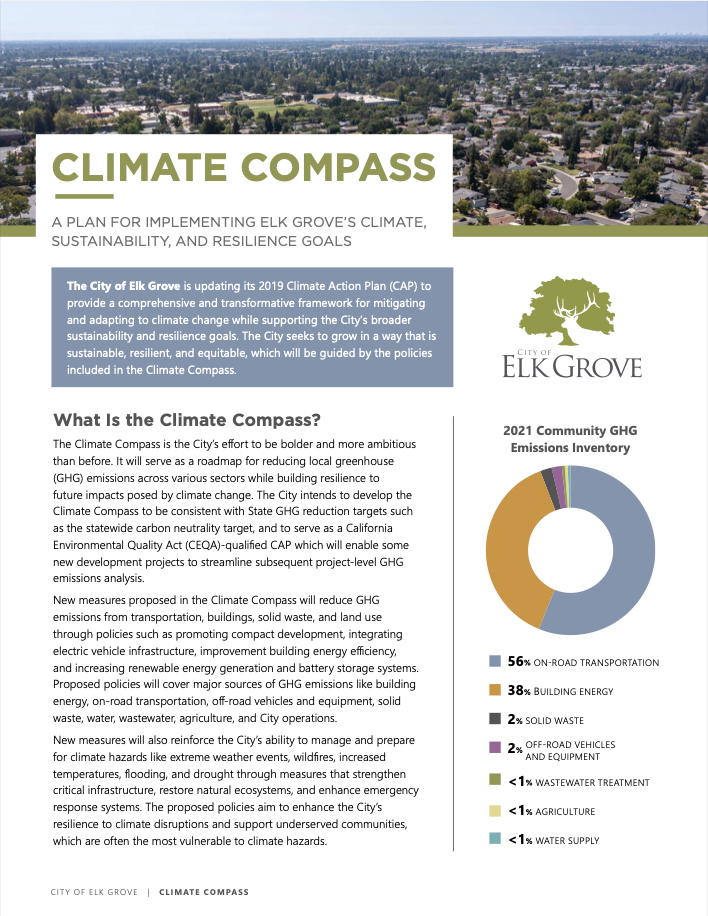
The communitywide inventory will include GHG calculations for on-road transportation, building energy, solid waste, off-road vehicles and equipment, wastewater treatment, water supply, and agriculture.
The City operations inventory will include GHG calculations for City-owned buildings and facilities, streetlights and traffic signals, employee commute, vehicle fleet, solid waste, wastewater treatment, and water supply.
Keep Up to Date
Sign up for email updates as the project progresses.
For questions contact [email protected].